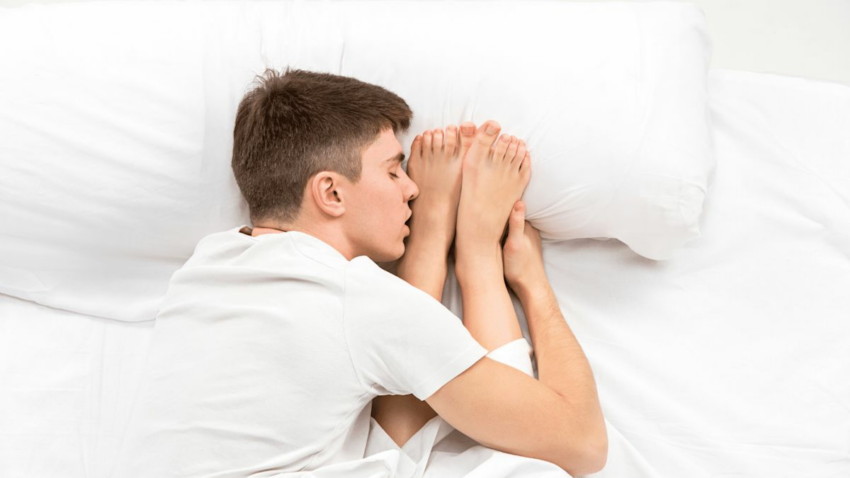
Sharing a mattress with a romantic partner triggers measurable neurobiological changes that increase rapid eye movement (REM) sleep by about 10% and synchronize brain-wave architecture throughout the night.
Modern couples face a growing cultural tug-of-war over how they handle their bedroom affairs. A national survey from the American Academy of Sleep Medicine (AASM) of 2,007 adults shows that 31% of Americans have opted for a “sleep divorce,” while an earlier AASM poll of 2,005 adults found that roughly 35% occasionally or consistently sleep in another room. Loud snoring, conflicting work schedules, and stolen blankets push 45% of men and 25% of women to relocate to guest rooms or couches.
Yet abandoning the shared marital bed carries a hidden neurological cost that most couples never consider. Landmark clinical research published in Frontiers in Psychiatry by Dr. Henning Johannes Drews and colleagues demonstrates that co-sleeping actively stabilizes dreaming sleep and aligns partners’ neural rhythms. Rather than simply enduring nighttime disturbances, a couple’s brains cooperate in the dark to build emotional resilience and protect mental health.
Inside the Lab Where Scientists Wired Up Co-Sleeping Partners
Researchers used dual, simultaneous polysomnography to monitor 12 healthy couples in both solo and shared-sleeping conditions, capturing deep brain-wave dynamics that standard movement trackers miss.
For decades, sleep science couldn’t settle whether couples rest better, worse, or just differently when sharing a bed. Earlier studies relied heavily on wrist actigraphy, which tracks only physical motion rather than brain activity, leading scientists to assume bed partners merely disrupt each other.
Advertisement
Advertisement
To solve that mystery, investigators at Germany’s Center for Integrative Psychiatry and Denmark’s Aarhus University recruited 12 young, healthy heterosexual couples (24 individuals aged 18 to 29) who habitually slept together. Each pair spent nights in a clinical sleep laboratory under two distinct setups: sleeping individually in separate rooms and co-sleeping in the same bed.
The team used dual simultaneous polysomnography, which Dr. Drews described as a “very exact, detailed and comprehensive method to capture sleep on many levels — from brain waves to movements, respiration, muscle tension, movements, heart activity.” Alongside those physiological recordings, researchers applied cross-recurrence quantification analysis to evaluate how relationship depth, social support, gender, and chronotype shaped nighttime brain coupling.
Related: Almost Half of Couples Secretly Do These 6 Things After Their Partner Falls Asleep
How Sharing a Mattress Supercharges and Stabilizes REM Sleep
Co-sleeping increases the overall proportion of nightly REM sleep and extends unbroken dreaming cycles by 64%, creating a potent biological buffer against emotional stress.
When partners shared a bed, their brains spent 23.0% of total sleep time in REM sleep, compared to 21.0% when sleeping alone (p=0.005). That shift means roughly 10% more REM sleep every night just from lying next to a partner. Even more impressive, co-sleeping cut nightly REM sleep fragmentations from 8.5 disruptions down to 5.4 (p=0.008) and lengthened continuous, undisturbed REM bouts from 13.4 minutes to 22.0 minutes (p=0.0006).
Advertisement
Advertisement
Remarkably, people who reported lower baseline social support experienced the biggest jump in REM duration when bed-sharing. That finding suggests nighttime closeness helps offset daytime social deficits.
Why does unbroken REM sleep matter so much for busy professionals and couples? During REM sleep, noradrenaline drops, and rhythmic theta-band brain waves consolidate memories while stripping stressful memories of their painful emotional sting. On the flip side, brain-imaging research shows that a single sleepless night leaves the amygdala about 60% more reactive to negative images, which quickly sparks relationship tension and short fuses.
Two Brains Ticking on One Clock Through Sleep Architecture Synchronization
Bed-sharing couples synchronize their sleep stages for nearly half the night, with deeply attached partners showing the strongest neural alignment.
Beyond boosting individual dreaming, sharing a mattress links two nervous systems into one coordinated rhythm. At zero time lag, meaning the exact same second, co-sleeping partners occupied identical sleep stages for 46.9% of the night, up from 36.6% when sleeping in separate rooms (p=0.005).
Advertisement
Advertisement
To make sure couples weren’t just waking each other up at the same time, researchers recalculated the data after removing all wakeful periods. True sleep-stage synchronization remained significantly higher during co-sleep (47.5%) than during solo sleep (p=0.02240.1%), and partners’ sleep cycles actively pulled one another into alignment across a 5 to 10 minute window.
Emotional intimacy acted as the secret fuel for this biological coupling. Participants who scored higher on measures of passionate “relationship depth,” reflecting intense emotional and mental absorption in their partner, achieved significantly stronger sleep-stage synchronization. Meanwhile, neither gender nor mismatched body clocks (like a morning lark dating a night owl) hindered REM gains or brain-wave synchrony.
Restless Limbs Versus Peaceful Brains in the Shared Bed
Although bed-sharing increases nightly leg movements by more than 20%, the sleeping brain filters out these physical twitches without losing deep slow-wave rest.
Critics of bed-sharing often point out that sleeping next to another person invites physical jostling. Laboratory recordings confirmed that total leg movements rose from an average of 50.9 per night during solo sleep to 61.5 per night during co-sleep (p=0.007).
Advertisement
Advertisement
Critically, however, those extra kicks and shifts never harmed overall sleep architecture or deep slow-wave sleep, and the slight uptick in brief awakenings wasn’t statistically significant (p=0.15). As Dr. Drews summed up the paradox, “one could say that while your body is a bit unrulier when sleeping with somebody, your brain is not.”
This split between restless muscles and a peaceful brain solves a longstanding puzzle in behavioral sleep medicine. Dr. Wendy Troxel, a senior behavioral scientist at the RAND Corporation, notes that “when sleep is measured objectively in couples, people sleep a bit worse when they share a bed” in terms of raw motion, yet most partners still prefer sleeping together. Because sleep is an evolutionarily vulnerable state, lying beside a trusted partner sends a primal safety signal that lets the brain dive into longer, unbroken REM cycles.
Weighing the Sleep Divorce Trend Against the Social Feedback Loop
Large-scale home sleep data confirm that stable partnerships boost REM sleep across the lifespan, though sleeping separately can still be a smart option when clinical sleep disorders strike.
Despite the neurological perks of bed-sharing, millions of couples alter their nighttime routines or move to separate beds just to survive the workweek. 31% to 35% of U.S. adults have tried sleeping in separate spaces, led by 43% of millennials and 45% of men; an even larger 37% sacrifice their preferred bedtime to match a partner’s schedule.
Advertisement
Advertisement
To verify that the 2020 laboratory results weren’t just a fluke caused by separating couples who were used to sleeping together, Dr. Drews and Annika Drews analyzed home polysomnography data from the Sleep Heart Health Study in a May 2021 Frontiers in Psychiatry follow-up. Looking at matched adults aged 40 and older in their own beds, the researchers confirmed that married individuals logged significantly more total REM sleep (76.527.7 minutes vs. 62.933.1 minutes, p=0.003) and a higher relative proportion of REM sleep than never-married peers.
Together, these findings point to a self-enhancing feedback loop between social connection and sleep. Close partnerships promote and stabilize REM sleep, helped along by body warmth, emotional security, and social circadian cues called zeitgebers, while richer REM sleep sharpens daytime memory, emotional balance, and creative problem-solving. Speaking on those daytime benefits, Dr. Drews remarked that “since these are well known effects of REM sleep, it is very likely that they would be observed if testing for them.”
Still, sleep specialists emphasize that sharing a bed isn’t a one-size-fits-all rule for every household. Dr. Erin Flynn-Evans, a consultant to the AASM, points out that “there are benefits for some partners to sleep separately” and notes that “studies demonstrate that when one bed partner has a sleep disorder it can negatively affect the other sleeper.”
When untreated snoring costs a partner up to an hour of rest each night, treating the root cause can save the shared bed: in a clinical trial of 10 couples where the snoring partner started continuous positive airway pressure (CPAP) therapy midway through the night, the partner’s sleep efficiency jumped from 74% to 87%. For couples who do choose separate rooms, a strategy Dr. Troxel rebrands as a “sleep alliance,” 52.9% report better sleep quality and gain an average of 37 extra minutes of rest, though 25.7% eventually return to the shared bed mostly because they miss each other.
The Pillow Talk Bottom Line

Sharing a bed delivers a scientifically verified boost to REM sleep stability and brain-wave synchrony, provided both partners are free of untreated disruptive sleep disorders.
For couples without severe snoring or clinical sleep disorders, staying under the same covers offers a remarkable neurological advantage. Co-sleeping expands dreaming sleep by 10%, lengthens unbroken REM cycles by 64%, and synchronizes partners’ brain waves for nearly 47% of the night, strengthening emotional resilience and relationship closeness.
What factors carry the greatest weight when couples decide between the REM-stabilizing closeness of a shared bed and the uninterrupted quiet of separate rooms, and how have different sleeping arrangements shaped relationship satisfaction in real-world households?
More Articles You Might Like:
Advertisement
Advertisement
The post Sleeping in the Same Bed May Mean More Stable REM Sleep and Better Sleep Synchronization for Couples appeared first on FODMAP Everyday.